
Document Control in Construction: More Than Keeping Files Organized
The best document control teams are often the ones you never notice.
That’s because when document control is working well, information moves where it needs to go without becoming an obstacle to the project.
Current drawings are accessible.
Approved submittals are easy to locate.
Specifications reflect the latest information.
Project records are organized and maintained.
Teams know where to look—and they trust what they find.
But when document control begins to break down, the impact doesn’t stay inside the document system.
It becomes a project execution problem.
What Happens When Project Information Loses Structure?
Construction projects generate an enormous amount of information throughout their lifecycle.
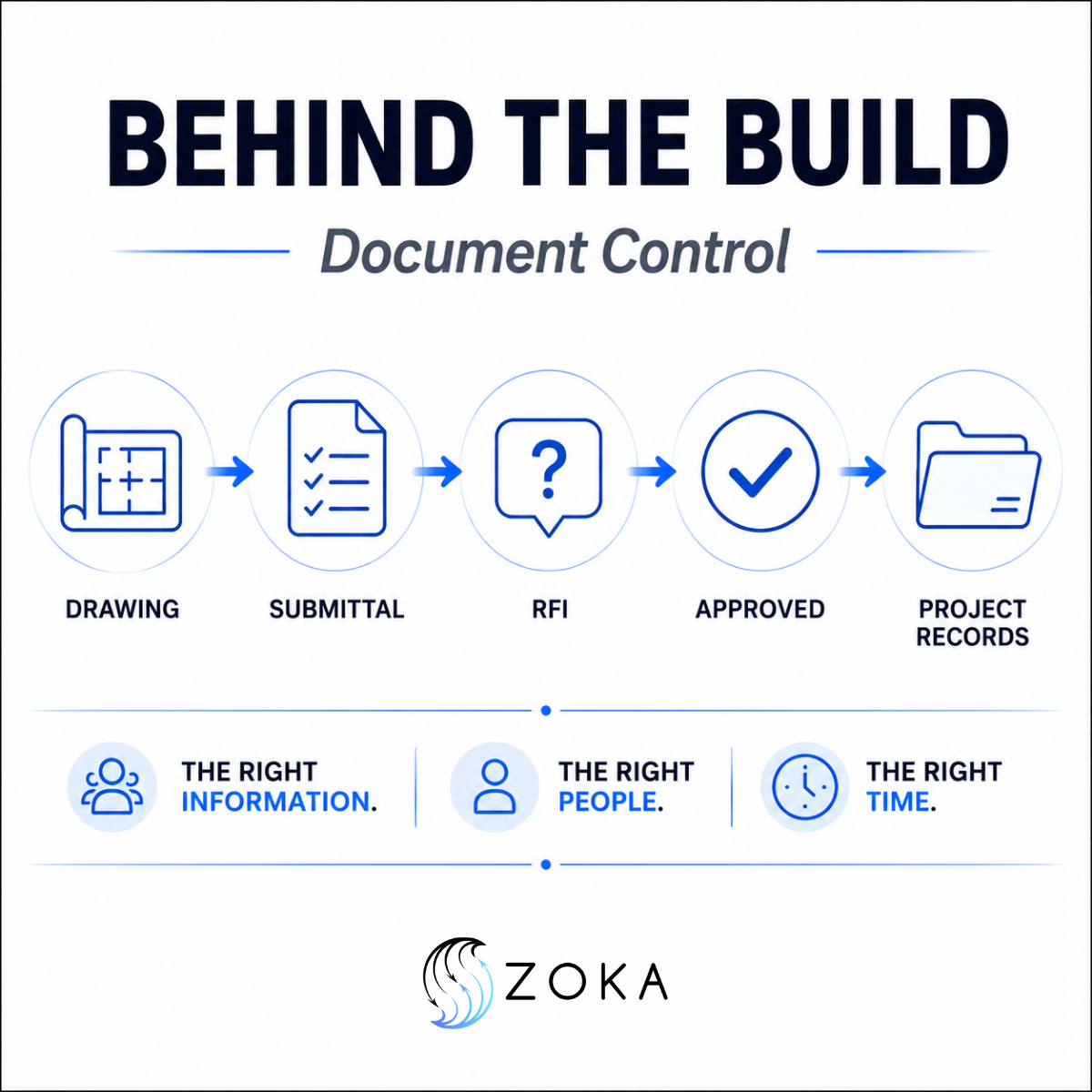
Drawings change. Submittals move through review. RFIs create new information. Specifications are updated. Decisions are documented. Vendors submit records. Closeout requirements begin accumulating.
The challenge isn’t simply storing all of it.
The challenge is making sure project teams can quickly determine what is current, what has changed, what is approved, what still requires action, and where the information belongs.
Without a consistent process, teams can begin relying on individual habits rather than a shared system.
One person saves documents one way. Another uses a different naming convention. Information gets downloaded and stored locally. Updated documents are distributed through email. Teams create separate trackers because they don’t trust the information available in the primary system.
Eventually, finding the correct information becomes work of its own.
Document Control Affects Project Decisions
Poor document control creates more than administrative frustration.
Consider what happens when someone can’t confidently answer a simple question:
“Is this the latest version?”
Someone may spend time searching for confirmation.
A field team could work from outdated information.
An approval may be overlooked.
A decision could be made using incomplete documentation.
Leadership may receive reporting that doesn’t reflect the project’s current status.
Each individual issue may seem small, but across a complex project, those gaps create unnecessary risk and rework.
Strong document control helps establish confidence that the information being used to make decisions and execute work is accurate, current, and accessible.
Good Document Control Requires More Than a Folder Structure
Technology can provide a place to store project information, but software alone doesn’t create document control.
Teams still need clearly defined processes for how information moves through the project.
That includes questions such as:
- Where should each type of document be stored?
- How should documents be named?
- Who is responsible for maintaining each record?
- How are revisions identified and communicated?
- How do teams know which version is current?
- What happens when information is missing?
- Who follows up on outstanding documentation?
- How are records maintained for eventual project turnover and closeout?
When those expectations aren’t defined, even sophisticated project management systems can become difficult to navigate.
The goal isn’t simply to create more rules.
It’s to establish enough consistency that everyone working on the project understands where information belongs and how it should be managed.
Ownership Is a Critical Part of Document Control
Every document doesn’t need executive attention.
But every important piece of project information should have a clear path through the organization.
Someone needs to know when a document has been received.
Someone needs to track whether an approval is outstanding.
Someone needs to make sure revised information reaches the appropriate people.
Someone needs to maintain the project record.
And someone needs to recognize when missing or outdated information should be escalated.
Without clear ownership, project information can easily fall into the gaps between teams.
Document Control Starts Before Closeout
One of the biggest advantages of strong document control is felt at the end of the project.
Closeout becomes significantly more difficult when teams wait until construction is nearly complete to determine whether required documentation has been collected.
Warranties, as-builts, O&M manuals, approvals, testing records, and other turnover requirements should not suddenly become a priority during the final weeks of a project.
When documentation is consistently organized and maintained throughout project delivery, closeout becomes a continuation of an existing process rather than a last-minute search for missing information.