

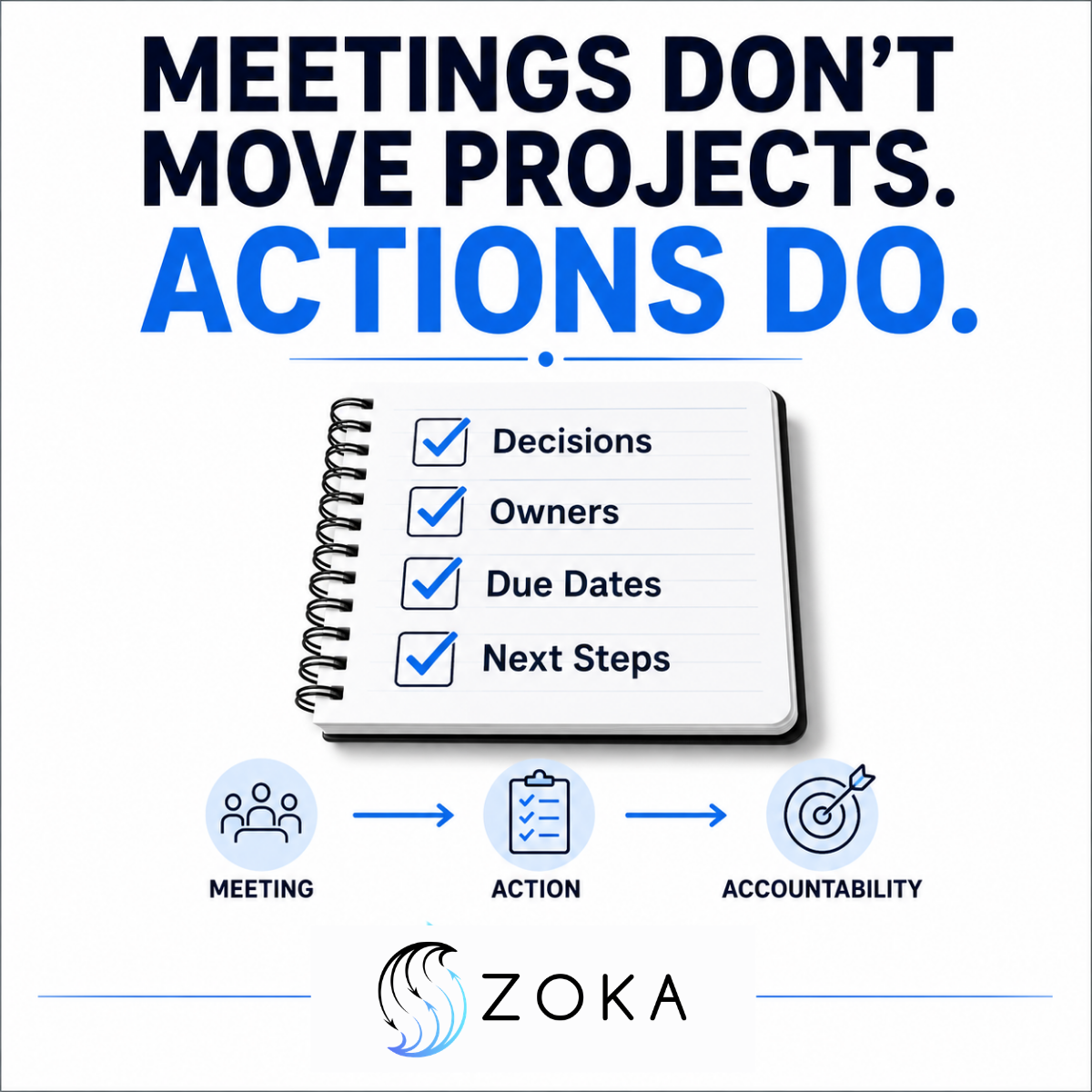
Meetings Don’t Move Construction Projects. Actions Do.
Construction projects require meetings.
Owner meetings. Project team meetings. Coordination meetings. Design meetings. Procurement meetings. Schedule reviews. Leadership updates.
A productive meeting can identify a risk, resolve an issue, clarify a responsibility, or result in an important project decision.
But the value of that meeting isn’t determined by what happens while everyone is sitting around the table.
It’s determined by what happens afterward.
Who owns the action?
When is it due?
Who needs to know about the decision?
Where is it tracked?
And how does the team know it actually gets done?
Without that structure, even a productive meeting can become another conversation everyone vaguely remembers having.
Meeting Minutes Are Only the Beginning
Meeting documentation is important, but documenting a conversation isn’t the same as managing its outcome.
Traditional meeting minutes may capture what was discussed, who attended, and perhaps a few general notes about next steps.
That’s useful for maintaining a project record.
But if an important action is buried on page four of the meeting minutes and nobody actively tracks it afterward, the documentation hasn’t necessarily helped move the project forward.
Effective meeting documentation should clearly capture:
- Decisions
- Action items
- Owners
- Due dates
- Next steps
More importantly, those items need to become part of the project’s ongoing tracking process.
Every Action Needs an Owner
One of the easiest ways for an action item to stall is for ownership to remain unclear.
Consider the difference between:
“Need updated pricing from vendor.”
and:
“Sarah to obtain revised vendor pricing by Thursday and provide it to the PM for review.”
The first identifies a need.
The second creates an action.
Clear ownership eliminates ambiguity about who is responsible for moving something forward. Adding a due date establishes when the team should expect movement.
That sounds simple, but on a complex construction project with hundreds of decisions and dependencies, consistently creating that clarity can make a significant difference.
Decisions Need to Travel Beyond the Meeting
Not everyone affected by a project decision is necessarily sitting in the meeting where that decision is made.
A design decision may affect procurement.
A procurement update may affect the schedule.
A schedule change may affect subcontractors.
A budget decision may require changes to reporting.
A revised owner requirement may affect documentation already in progress.
That’s why good meeting management also considers:
Who else needs this information?
The meeting itself is only one point in the project’s communication process. Decisions need to move from the people who made them to the people responsible for acting on them.
Without a defined communication process, teams can leave the same meeting with different understandings of what happens next.
Action Items Shouldn’t Live Only in Meeting Minutes
If the only place an action item exists is inside a set of meeting minutes, the team may not see it again until someone prepares for the next meeting.
By then, a week—or more—may have passed.
Critical actions should move into whatever system the project uses to manage ongoing work and accountability.
That could be a project management platform, action-item log, task-management system, workflow, or another established tracking process.
The specific technology matters less than the discipline behind it.
The team should be able to answer:
What is still open?
Who owns it?
When is it due?
What is preventing it from being completed?
Does it need to be escalated?
That creates visibility between meetings rather than waiting for the next meeting to discover that nothing happened.
Follow-Through Is an Operational Process
When action items repeatedly disappear after meetings, the problem may not be that people don’t care.
It may be that the organization hasn’t established a consistent process for managing follow-through.
Someone needs to capture the action.
Someone needs to assign ownership.
Someone needs to establish a due date.
Someone needs to track its status.
And when an item remains unresolved, there needs to be a clear escalation path.
This is where meeting management becomes part of a company’s larger operational infrastructure.
The objective isn’t to create more administrative work.
It’s to make sure decisions translate into execution.
Better Meetings Create Better Project Visibility
Consistent action tracking also improves reporting.
Instead of leadership hearing that something was “discussed last week,” teams can provide a much clearer picture:
The decision was made.
The action was assigned.
The owner is identified.
The deadline is established.
The item is complete—or it isn’t.
And if it isn’t, the team knows why.
That level of visibility helps project teams identify stalled decisions and emerging risks earlier, while there is still time to respond.
Turn Conversations Into Execution
At ZoKa Solutions, we help organizations establish the operational processes that connect project communication to action.
That can include meeting coordination and documentation, action-item tracking, ownership and accountability structures, reporting, escalation workflows, and project management systems that provide ongoing visibility into what needs to happen next.
Because a productive meeting isn’t measured by how much was discussed.
It’s measured by what happened because of it.
Meetings don’t move projects. Actions do.