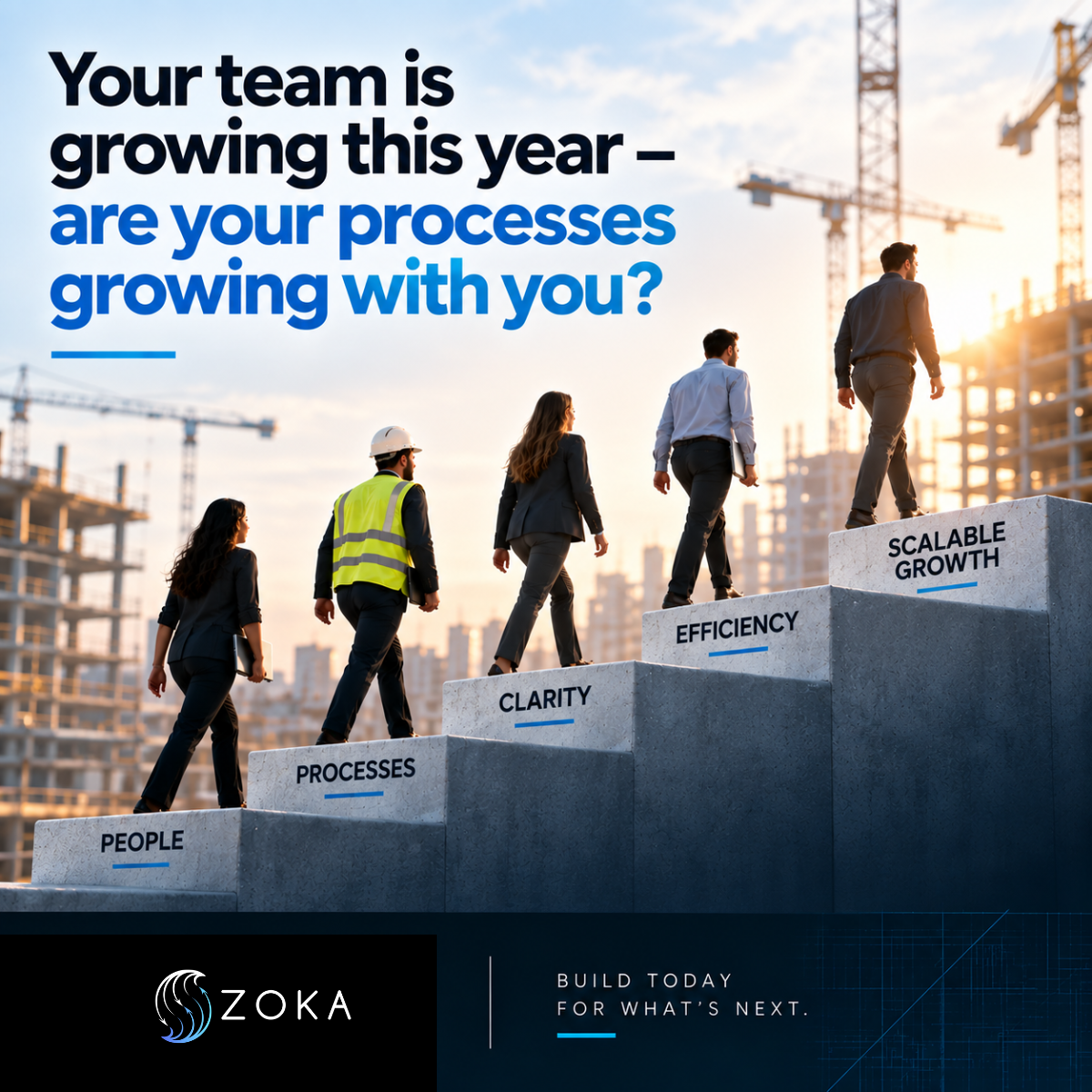
Your Team Is Growing. Are Your Processes Growing With You?
Growth is usually a good problem to have.
More projects, new clients, expanding teams, and increasing workloads can all signal that an organization is moving in the right direction.
But growth doesn’t just add people.
It adds handoffs, approvals, responsibilities, communication paths, systems, and decisions. Processes that worked well when five people were involved may become much harder to manage when ten or twenty people are touching the same work.
That’s why adding capacity and building scalable operations need to happen together.
Growth Changes How Work Moves
In a smaller team, a surprising amount of operational knowledge can live informally.
Someone knows who needs to approve a change. Another person remembers where a particular document is stored. A Project Manager knows which spreadsheet needs to be updated. A longtime employee knows who to call when something falls outside the normal process.
That can work—until the organization grows.
As new people join the team, they need answers to questions existing employees may rarely have to ask:
Where are the SOPs?
Which workflow should I follow?
Who owns each step?
Where does the information I need live?
What happens when something doesn’t follow the normal process?
If the answers primarily live in someone’s head, onboarding becomes dependent on who is available to explain them.
The result can be inconsistent training, different ways of completing the same work, and new employees taking longer to become confident in their roles.
Adding People Doesn’t Automatically Create Capacity
Hiring someone increases headcount.
Creating an environment where that person can work effectively increases capacity.
There’s an important difference.
When processes aren’t clearly defined, new employees often have to learn by asking questions, watching coworkers, searching through old examples, or developing their own way of completing a task.
Eventually, that can create multiple versions of the same process.
One Project Manager follows one workflow. Another follows a slightly different one. A third maintains an additional spreadsheet because that’s how they learned to track the information.
None of those individuals necessarily did anything wrong.
The organization simply didn’t provide a clear, repeatable operating structure.
SOPs Are Only Part of the Solution
Documenting Standard Operating Procedures is an important part of creating consistency, but scalable operations require more than a folder full of SOPs.
Employees also need to understand how those procedures connect to their actual work.
A strong operational structure should make it clear:
- What needs to happen
- Who owns each responsibility
- When an action or handoff should occur
- Where information should be documented
- Which system or tool supports the process
- What happens when an exception occurs
That’s where SOPs, workflows, ownership structures, systems, training, and governance begin working together.
The goal isn’t simply to document how work gets done.
It’s to create a repeatable way of working that people can understand and follow.
Training Turns Documentation Into Adoption
Even a well-designed process won’t create consistency if employees don’t know it exists—or don’t understand how to use it.
That’s why training should be part of process development, especially during periods of growth.
New and existing employees should understand where resources live, how workflows move, what they’re responsible for, how their work affects the next person in the process, and where to go when something doesn’t fit the standard workflow.
This is particularly important when processes involve technology.
Whether a team is working in Procore, an ERP, SharePoint, a reporting platform, or another business system, employees shouldn’t only know which buttons to click.
They should understand the process the technology is supporting.
That context makes adoption easier and helps prevent employees from creating workarounds when they’re unsure what to do.
Build for the Team You’re Becoming
Processes shouldn’t become unnecessarily complicated simply because an organization is growing.
In fact, the opposite should be true.
Growth is an opportunity to look at how work moves through the organization and determine what needs to become clearer, more consistent, or more scalable.
Which processes still depend heavily on individual knowledge?
Where are new employees asking the same questions repeatedly?
Which workflows are handled differently depending on the person or project?
Where are handoffs creating delays or confusion?
Which responsibilities don’t have clear ownership?
Those are often signals that the operational infrastructure hasn’t caught up with the organization’s growth.
Turning Growth Into Scalable Operations
At ZoKa Solutions, we help construction and other project-based organizations build and strengthen the operational infrastructure behind their work.
That can include developing SOPs, mapping workflows, defining ownership and responsibilities, documenting processes, improving system utilization, and establishing the structure teams need to operate consistently as they grow.
And the work doesn’t have to end when the documentation is complete.
We can also help organizations onboard and train new and existing employees on those processes—helping teams understand not only what the process is, but how the pieces connect and why the process exists.
Adding people can increase capacity.
Giving those people a clear, repeatable way to work is what helps that capacity scale.