
Closeout Starts at Project Startup: How to Build a Smoother Construction Closeout Process
Project closeout is often treated as the final phase of construction.
The work is nearly complete, the project team is preparing for turnover, and someone begins gathering the documentation required to officially close the project.
That’s when the missing items start appearing.
An O&M manual was never submitted. A warranty is sitting in someone’s email. As-built drawings haven’t been updated. A document was uploaded under the wrong name, making it difficult to locate. A subcontractor has moved on to another project, and the team is trying to track down information that should have been collected months earlier.
Suddenly, what should be a final review becomes a document recovery effort.
The issue isn’t necessarily that the team failed to work on closeout.
It’s that closeout wasn’t established as an ongoing process from the beginning.
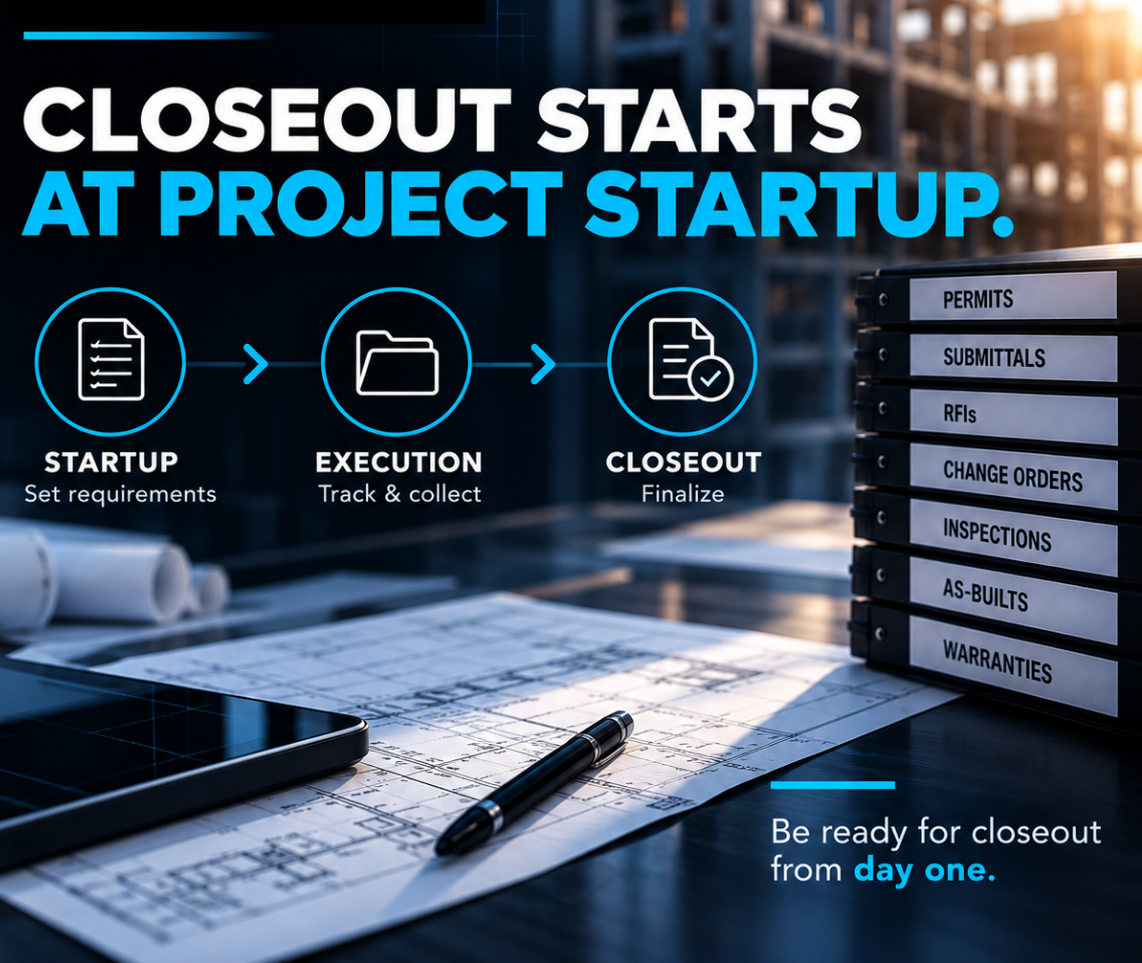
A smoother construction closeout starts at project startup, with clear requirements, consistent tracking, and documentation collected throughout the project lifecycle.
Why Waiting Until the End Creates Problems
Construction projects generate an enormous amount of information.
Throughout the project, teams manage submittals, RFIs, change orders, inspections, product information, warranties, drawings, meeting records, and other contractual documentation.
Some of that information will be required for final turnover. Other records may be necessary to demonstrate that project obligations have been satisfied.
When closeout requirements aren’t identified and tracked early, project teams can reach the final stages of construction without a clear picture of what’s complete and what’s still missing.
That creates several challenges.
Missing documentation becomes harder to recover. Subcontractors and vendors may have already completed their work, making outstanding documents more difficult to obtain.
Information becomes fragmented. Documents may be scattered across emails, shared drives, individual computers, and project management platforms.
Project teams spend time reconstructing the past. Instead of finalizing deliverables, employees must determine which documents were submitted, which versions are current, and who is responsible for outstanding items.
Turnover becomes less predictable. Incomplete documentation can delay administrative completion and, depending on contract requirements, affect final payment or other closeout milestones.
These challenges aren’t always caused by a lack of effort.
Often, they result from not having a defined process for managing closeout requirements while the project is active.
1. Establish Closeout Requirements During Project Startup
The first step toward a smoother closeout is understanding exactly what the project requires.
Closeout expectations can vary significantly depending on the owner, contract, project type, and applicable systems.
Some projects require extensive O&M documentation, equipment warranties, training records, commissioning documentation, or specific as-built drawing formats.
Others have particular naming conventions, submission procedures, or electronic turnover requirements.
Those expectations should be identified before the project is underway.
During startup, the team should review the applicable contract documents and specifications to determine:
-
Which closeout deliverables are required.
-
Who is responsible for providing each item.
-
When the documentation should be submitted.
-
Which format and naming conventions are required.
-
Where the documents will be stored and reviewed.
-
Who is responsible for approving or accepting each deliverable.
These requirements provide the foundation for a closeout process that can be managed throughout the project.
Rather than discovering expectations at the end, the team begins with a clear understanding of what successful turnover requires.
2. Build a Closeout Log That Tracks More Than Missing Documents
Once the requirements are identified, they need to be organized into a system the team can maintain.
A closeout log provides visibility into outstanding deliverables and helps establish accountability.
At a minimum, the log should identify the required document, responsible party, anticipated submission date, current status, and any necessary review or approval.
For larger or more complex projects, additional information may be useful, such as specification references, equipment or system associations, revision information, and reviewer comments.
The objective is to create a reliable way to answer three important questions:
What do we need? Who owes it? Where does it stand?
Without that visibility, teams may not recognize missing documentation until the final stages of the project.
With a maintained closeout log, outstanding items can be identified and addressed while the responsible parties are still actively engaged.
The log should also reflect the project’s actual requirements rather than relying exclusively on a generic checklist.
A standardized template can provide a starting point, but the final tracking structure should align with the contract and owner’s expectations.
3. Collect Documentation Throughout the Project
One of the most effective ways to reduce closeout challenges is to collect documents as they become available.
Not every closeout deliverable can be completed early. Final as-built drawings, certain testing records, and other turnover materials may depend on work that occurs later in the project.
However, many documents can be collected, reviewed, or prepared well before substantial completion.
Product information and warranty requirements can be identified during procurement.
Approved submittals can help establish which equipment and materials will require turnover documentation.
Inspection and testing records can be organized as work progresses.
Equipment information and O&M manuals can be requested when appropriate rather than waiting until the subcontractor has demobilized.
The goal isn’t to complete closeout prematurely.
It’s to prevent documentation that could have been collected earlier from becoming an unnecessary problem at the end.
Collect what you can when it becomes available, and maintain visibility into what still needs to be completed.
4. Establish Consistent Document Naming and Organization
Having all the required documents doesn’t help much if no one can find them.
Document organization is a critical part of an effective closeout process.
When files are uploaded with inconsistent names, stored in different locations, or saved without clear version information, teams may spend significant time identifying the correct records.
Consider a project with multiple pieces of equipment.
A file named Warranty_Final_2.pdf may not clearly identify the equipment, subcontractor, or system it belongs to.
A consistent naming convention can make that information easier to locate and verify.
The exact structure should reflect the project’s requirements, but the process should establish expectations for document titles, folder organization, version control, and the designated storage location.
For organizations using Procore, that may involve establishing consistent practices within the applicable project tools and document management structure.
The important consideration is consistency.
When everyone understands where documentation belongs and how it should be identified, closeout information becomes easier to manage throughout the project and retrieve during turnover.
5. Assign Ownership and Maintain Follow-Through
A closeout log is only effective if someone is responsible for keeping it current.
Project teams should establish who owns the overall closeout process and who is responsible for individual deliverables.
For example, a subcontractor may be responsible for submitting an O&M manual, while a Project Coordinator tracks the requirement and a Project Manager or designated reviewer confirms that the submission meets the contract requirements.
Those responsibilities should be clear.
Regular follow-ups can then focus on specific outstanding items rather than broad requests for everyone to submit their closeout documents.
The process should also establish when issues need to be escalated.
If a required document is repeatedly delayed or a submission doesn’t meet the owner’s requirements, the team needs a defined way to address it before it becomes a last-minute obstacle.
Consistent ownership and follow-through help keep closeout moving alongside the rest of the project.
6. Review Closeout Readiness Before the Final Push
As the project approaches completion, the team should have a reliable picture of its closeout status.
This is the time to review outstanding deliverables, verify that submitted documents are complete, confirm that required approvals have been obtained, and identify any remaining turnover obligations.
A readiness review might examine whether:
-
Required documentation has been received and organized.
-
Outstanding items have assigned owners and target dates.
-
As-built drawings and other final records are progressing.
-
Warranties and O&M manuals meet the applicable requirements.
-
Training, testing, commissioning, and turnover obligations are being tracked where required.
-
The final submission package aligns with the owner’s expectations.
The review should identify what remains to be finalized, not reveal an entirely new list of requirements.
When closeout has been managed throughout the project, the final phase becomes more predictable.
Closeout Is a Project-Lifecycle Responsibility
A successful closeout process doesn’t begin when construction is nearly finished.
It begins when the team identifies the requirements, establishes ownership, and creates a reliable way to track documentation.
It continues through procurement, construction, inspections, and project coordination.
And it concludes with a final review and turnover of the required deliverables.
By treating closeout as an ongoing responsibility, construction organizations can reduce the need to chase missing documents, reconcile incomplete information, and reconstruct decisions made months earlier.
The goal isn’t simply an easier closeout at the end.
It’s being ready for closeout from the beginning.