

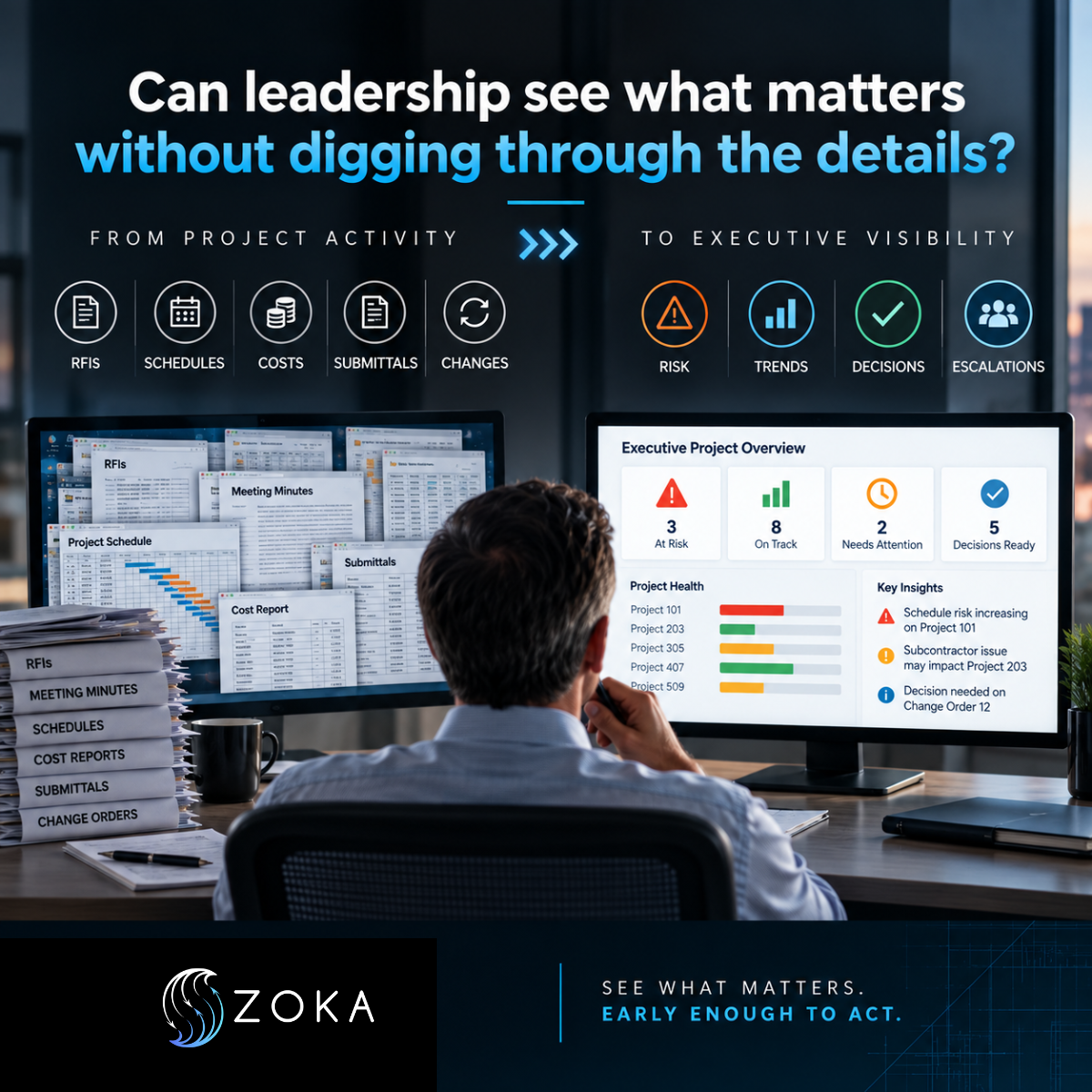
Leadership Doesn’t Need Every Field-Level Detail — Just the Right Signal at the Right Time
Construction projects generate an enormous amount of information.
RFIs are opened and closed. Submittals move through review. Schedules change. Costs are updated. Change events develop. Meetings produce decisions and action items. Procurement milestones shift. Issues emerge in the field.
All of that information matters.
But not all of it belongs in front of executive leadership.
The challenge is creating a clear connection between the activity happening at the project level and the information leadership needs to make timely decisions.
When that connection is missing, executives can find themselves digging through reports, sitting through lengthy status meetings, or asking project teams for additional context just to answer a relatively simple question:
Where does my attention need to be right now?
More Project Data Doesn’t Automatically Create Better Visibility
Construction organizations have access to more project information than ever before. Platforms such as Procore, ERP systems, scheduling tools, document management platforms, and reporting solutions can capture tremendous amounts of data throughout the project lifecycle.
But access to information and visibility are not the same thing.
A leadership dashboard can contain dozens of metrics and still fail to communicate what actually requires attention.
A weekly report can be ten pages long and still leave an executive asking what changed since last week.
And a project can appear healthy at a high level while individual indicators are beginning to point toward a future problem.
Effective executive reporting isn’t about moving every piece of project information up the organization.
It’s about identifying the signals within that information that matter.
What Should Leadership Actually See?
The answer will vary by organization, project type, and leadership role, but executive reporting should help decision-makers quickly understand four things:
Where is risk developing?
An individual RFI may not require executive attention. A growing pattern of unanswered RFIs affecting critical-path activities might.
Where is momentum changing?
One delayed activity may be manageable. Several related milestones beginning to move in the same direction may indicate a larger schedule or coordination issue.
What decisions are ready to be made?
Leadership shouldn’t have to search through meeting minutes or email chains to discover that a decision is waiting for them.
Where would escalation make a difference?
Some issues belong with the project team. Others reach a point where executive involvement can remove a roadblock before it becomes a larger problem.
The goal is not to eliminate project-level detail. Project teams still need it to manage the work.
The goal is to create a reporting structure that translates that detail into meaningful executive visibility.
The Signal Starts With the Process
A dashboard is only the final layer.
Before leadership can receive reliable information, the processes behind that information have to work.
That means organizations need to understand where project information originates, who is responsible for maintaining it, how frequently it is updated, when an issue should be escalated, and how information moves from individual projects into portfolio or executive reporting.
Without those expectations, reporting can quickly become inconsistent.
One Project Manager may identify a risk differently than another. Teams may update information at different intervals. Issues may remain at the project level longer than leadership expects. Reports may require someone to manually collect information from multiple systems before every executive meeting.
The result can be a lot of information without a consistent way to interpret it.
Executive Reporting Should Lead to Action
The most valuable project reporting doesn’t simply describe what happened.
It helps someone determine what happens next.
If a report identifies an emerging risk, who needs to respond?
If a decision is required, who owns it and when is it needed?
If a trend begins moving in the wrong direction, when does it become an escalation?
If leadership takes action, how is the outcome tracked?
This is where project controls, governance, reporting, and accountability begin working together.
The reporting structure becomes more than a communication tool. It becomes part of the organization’s decision-making process.
Building the Connection Between Projects and Leadership
At ZoKa Solutions, we help construction and project-based organizations strengthen the operational infrastructure connecting project execution to leadership visibility.
That can include establishing reporting structures, defining project controls, standardizing information and escalation processes, improving workflows, connecting systems, and clarifying how information moves from the people managing the work to the people making broader organizational decisions.
The objective isn’t to give executives another dashboard to review.
It’s to make sure the information reaching them is consistent, meaningful, timely, and actionable.
Because executive visibility isn’t about seeing everything happening on every project.
It’s about seeing what matters early enough to do something about it.