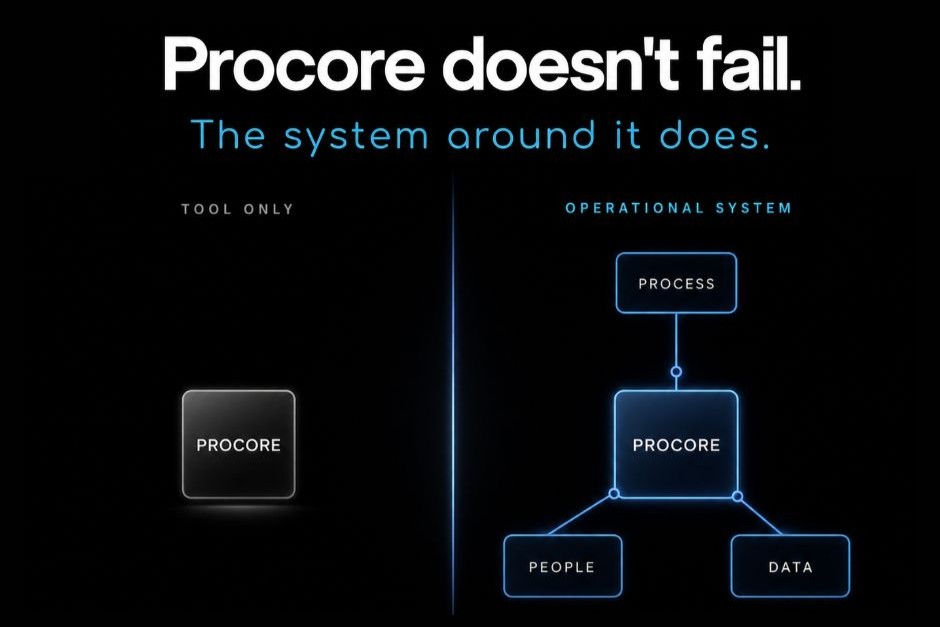
Procore is a powerful construction management platform. But implementing the technology is only one part of making it successful.
A company can purchase the platform, configure its tools, migrate its information, and train its team — and still struggle with adoption months later.
The problem isn’t necessarily the technology.
Often, the operational structure surrounding it was never fully defined.
Software Doesn’t Create the Process
Construction technology works best when it supports an established way of working.
Before a team can consistently use Procore, there need to be clear answers to operational questions such as:
- Who is responsible for entering and maintaining information?
- When should information be updated?
- What does the approval process look like?
- Which system is the source of truth?
- How should information move between the field, project teams, accounting, and leadership?
- What information does leadership actually need to see?
- Who is accountable when a workflow stalls?
Without those decisions, teams are left to determine their own way of using the platform.
That’s when inconsistencies begin.
One project team develops one process. Another develops something different. Some information lives in Procore while other information continues to live in spreadsheets, emails, Teams messages, or individual tracking systems.
The technology may be implemented, but the operation hasn’t changed with it.
Training and Adoption Aren’t the Same Thing
Training teaches someone where to click.
Adoption happens when using the system becomes part of how the organization operates.
That’s an important distinction.
A team may understand how to create an RFI, update a commitment, enter information, or generate a report. But if responsibilities, expectations, and workflows haven’t been established, knowing how to use the tool doesn’t guarantee that it will be used consistently.
Over time, teams naturally create workarounds to get their jobs done.
Those workarounds can eventually recreate the same problems the technology was intended to solve: duplicate entry, inconsistent reporting, disconnected information, and limited visibility.
Reporting Starts With the Workflow
Leadership reporting is often where these gaps become most visible.
Organizations invest in construction technology expecting better access to project information. But a dashboard or report is only as reliable as the processes feeding information into it.
If updates happen inconsistently, ownership isn’t clear, or critical information is maintained outside the platform, leadership may still find itself questioning the data.
The reporting problem isn’t necessarily the report.
It may begin much earlier in the operational workflow.
The Operational Layer Matters
Getting more value from Procore often requires looking beyond configuration and asking whether the organization has built the structure necessary to support it.
That structure can include:
- Clearly defined workflows
- Ownership and accountability
- Standard operating procedures
- Consistent project expectations
- Reporting frameworks
- System integrations
- Governance
- Ongoing adoption and process improvement
When those pieces work together, technology becomes part of the operation rather than another system the team has to manage.
Technology Is Only One Part of the System
Successful technology implementation isn’t simply about turning software on.
It’s about aligning people, processes, technology, and information so the platform supports how work actually gets done.
When Procore adoption is struggling, the answer isn’t always more training or another configuration change.
Sometimes the better question is:
Have we built the operational structure around the technology that allows it to succeed?
ZoKa Solutions helps construction organizations build that operational layer through workflow development, governance, accountability systems, reporting frameworks, and ongoing operational support.
For organizations already invested in Procore, the goal isn’t simply to use the platform.
It’s to make the investment work.