
Your Team Knows How the Work Gets Done. Does Your Organization?
Asking the people doing the work is one of the best places to start when evaluating a process.
But asking the question is only the beginning.
When employees explain how work actually gets done, the answer is rarely as simple as the process map, procedure, or system suggests.
You start hearing things like:
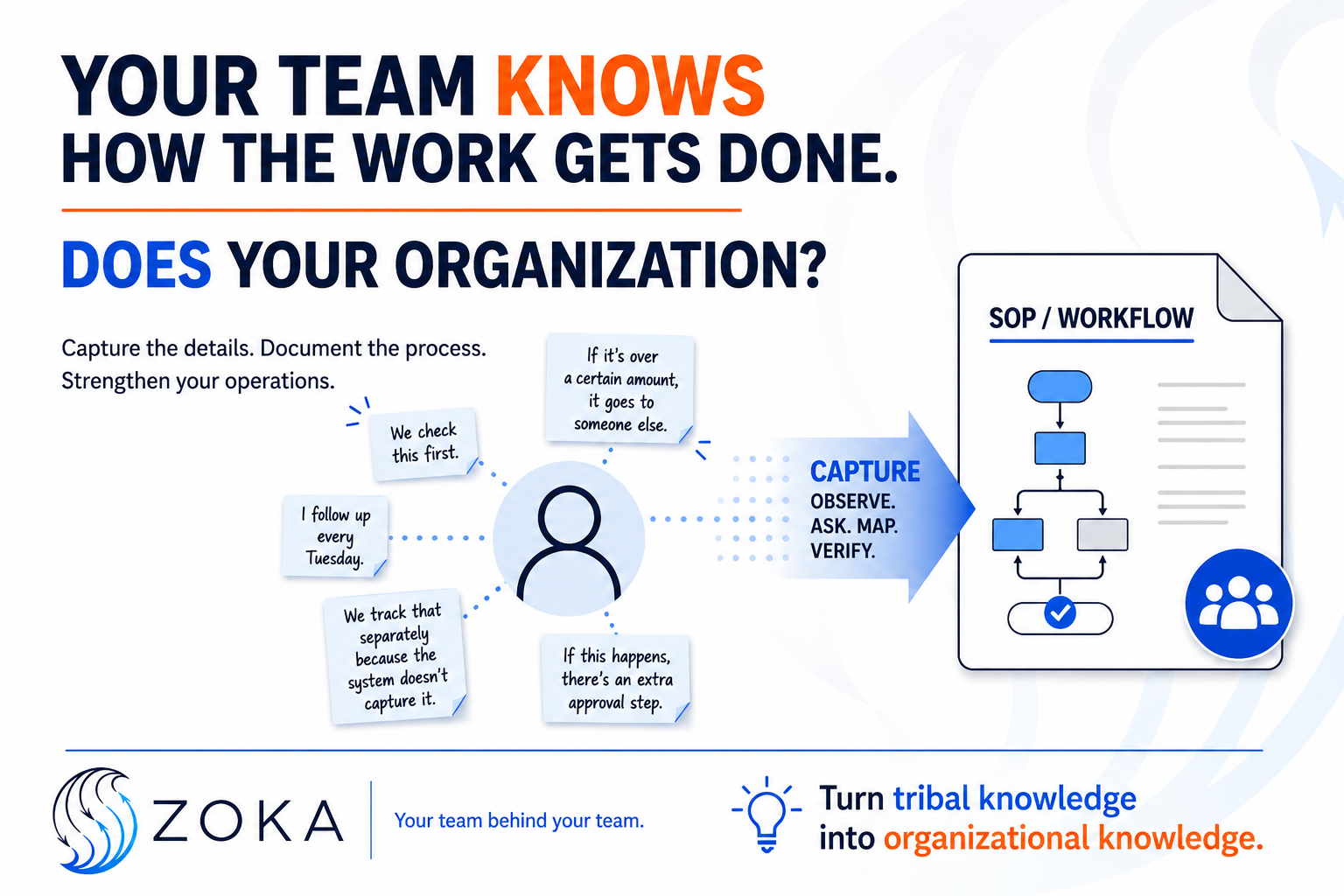
“We check this first.”
“If it’s over a certain amount, it goes to someone else.”
“I follow up every Tuesday.”
“We track that separately because the system doesn’t capture it.”
“If this happens, there’s an extra approval step.”
Those details may sound small, but they represent something incredibly valuable: operational knowledge.
And when that knowledge lives primarily with the people doing the work, an organization can become dependent on what individuals know rather than what the organization has documented.
The Written Process vs. the Working Process
Most organizations have processes. Fewer have processes that completely reflect how work happens day to day.
A workflow may have been designed when a system was first implemented. An SOP may have been written before responsibilities changed. A new approval requirement may have been added without updating the original documentation.
Over time, employees adapt.
They create reminders. They add spreadsheets. They develop additional checks. They learn who actually needs to approve something. They know which exceptions require another step.
Eventually, there can be two versions of the process:
The process that is documented — and the process the team actually follows.
That gap matters.
When the real process depends on individual knowledge, it becomes harder to train new employees, maintain consistency, identify inefficiencies, improve workflows, or understand where responsibility actually sits.
Listening Uncovers the Process
Understanding the real process starts with the people closest to the work.
Ask them to walk through what happens from beginning to end — not simply what is supposed to happen.
Then dig into the details.
What happens next?
Who owns that step?
What information do they need?
Where does that information come from?
What happens when something falls outside the normal process?
What are they tracking somewhere else?
Where do they typically have to follow up?
This is often where the undocumented parts of a workflow begin to surface.
The goal isn’t simply to record what someone says. It’s to understand how work moves through the organization.
Turn Knowledge Into a Repeatable Process
Once the actual process is understood, the next step is capturing it in a form the organization can use.
That may mean:
Observe the process. See how the work actually happens rather than relying solely on existing documentation.
Ask questions. Understand why certain steps, approvals, checks, or workarounds exist.
Map the workflow. Identify how information and responsibility move from one person, department, or system to another.
Identify exceptions. Document what happens when the normal path doesn’t apply.
Validate it with the team. The people using the process should be able to recognize the workflow you’ve documented.
Create usable documentation. An SOP should help someone perform the work — not simply prove that a procedure exists.
The result is more than an SOP.
It’s organizational knowledge that can be repeated, trained, evaluated, and improved.
Good Documentation Creates a Foundation for Improvement
Documenting the real process doesn’t mean every workaround should become permanent.
In fact, capturing the workflow often makes opportunities for improvement much easier to see.
Why is someone maintaining a separate spreadsheet?
Why does the same information need to be entered twice?
Why does an approval depend on someone remembering to send an email?
Why does only one person know how to complete a particular step?
Once the real workflow is visible, organizations can begin deciding what should be standardized, simplified, automated, reassigned, or eliminated.
That is where process documentation becomes more than administrative work. It becomes part of building stronger operational infrastructure.
Keep the Knowledge Inside the Organization
At ZoKa Solutions, we help organizations understand how work is actually being performed and turn that knowledge into practical SOPs, workflows, ownership structures, and repeatable processes.
Because listening to your team can uncover how the process really works.
Documenting it helps your organization keep that knowledge — and gives you a foundation to improve it.